


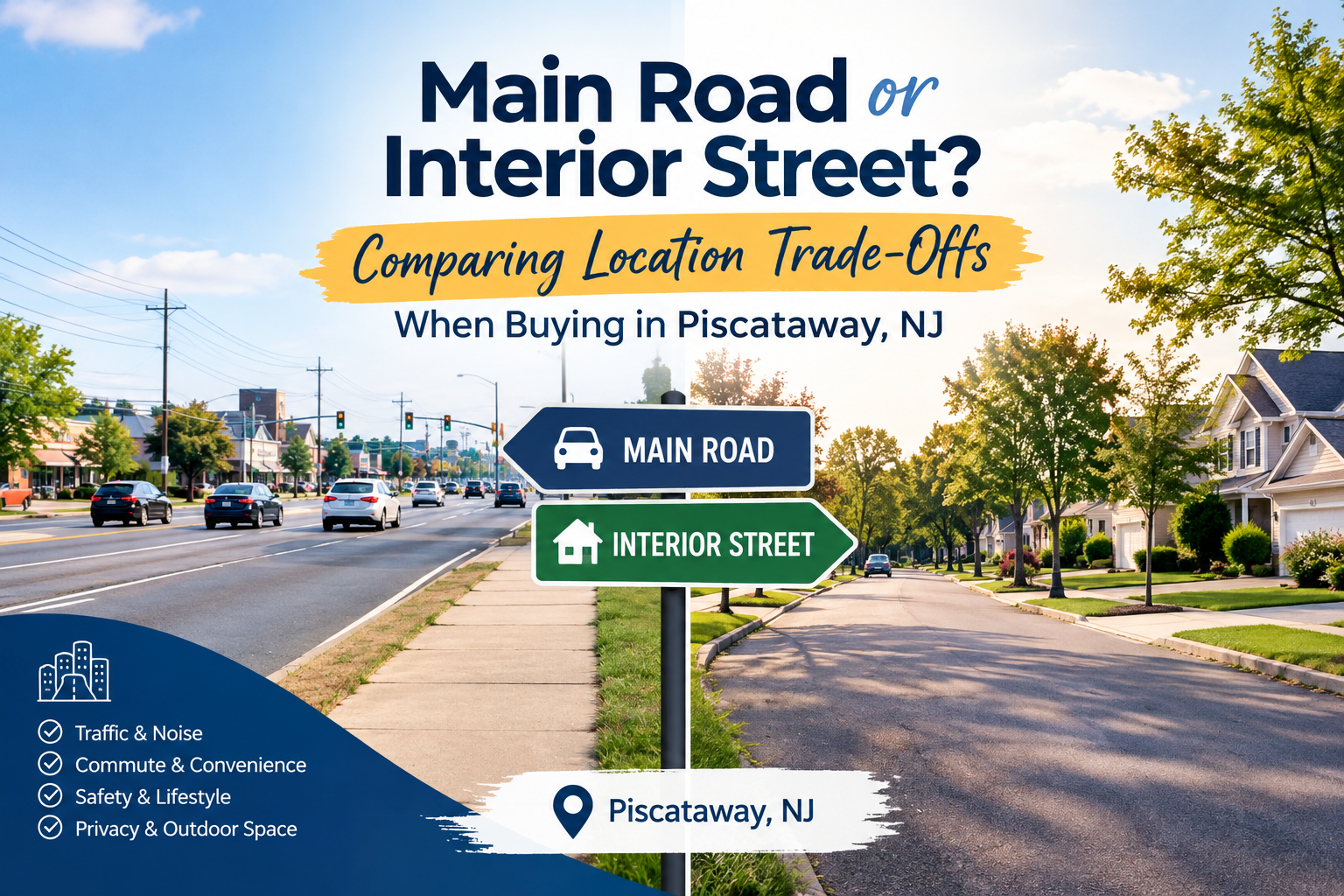
When buying a home in Piscataway, NJ, the property itself is only part of the decision. The street where the home is located can also affect your daily routine, comfort, commute, and future resale appeal. Two homes with similar layouts and square footage may offer very different living experiences simply because one is on a main road and the other is on an interior residential street.
For homebuyers exploring Piscataway and the wider Middlesex County real estate market in 2026, understanding these location trade-offs can help you make a more informed decision. Neither location is automatically better. The right choice depends on your priorities, budget, lifestyle, and how the property fits your long-term plans.
1. Understand the Difference Between Main Roads and Interior Streets
A main road typically carries more traffic and connects neighborhoods to major destinations, shopping areas, employment centers, or other local roads. Depending on the location, a home on a main road may offer convenient access to nearby services and transportation routes.
An interior street is generally located within a residential neighborhood and may experience less through traffic. However, traffic levels can vary significantly. Some interior streets are busy during school drop-off and pickup times, while others remain relatively quiet throughout the day.
In Piscataway, buyers should evaluate the actual street rather than relying only on the property's address or neighborhood name. Traffic patterns, nearby intersections, road access, and surrounding land uses can all influence the experience of living there.
2. Traffic, Noise, and Everyday Comfort
One of the most noticeable differences between main-road and interior-street properties is the amount of traffic nearby.
Homes along busier roads may experience more vehicle noise, headlights, delivery traffic, and activity during peak commuting hours. The impact depends on traffic volume, speed limits, road design, distance from the roadway, landscaping, and the home's construction.
Interior streets may offer a quieter setting, particularly when they have limited through traffic. However, it is still important to check for nearby schools, parks, intersections, commercial properties, or other sources of activity.
What should buyers do?
-
Visit the property during morning and evening commuting hours.
-
Return during the evening or on a weekend to compare noise levels.
-
Spend a few minutes outside near the front and backyard.
-
Check whether traffic noise is noticeable inside with the windows closed.
-
Ask about any planned roadwork or changes that could affect access.
A short visit in the middle of the day may not reveal the conditions you will experience during your normal routine.
3. Convenience and Commuting Access
A home on a main road may provide easier access to major routes, bus stops, shopping areas, or employment destinations. For buyers who commute regularly or need to travel frequently, this convenience can be a meaningful advantage.
However, being close to a major road does not always mean getting to your destination faster. Traffic congestion, difficult turns, signal timing, and peak-hour backups can make some routes less convenient than they appear on a map.
Interior streets may require additional driving before reaching a main road, but some buyers may prefer that separation from busy traffic.
When comparing homes in Piscataway, test the routes you expect to use regularly. Consider the drive to work, grocery stores, medical appointments, schools, and other destinations important to your household.
If public transportation is part of your routine, check the walking route, sidewalk conditions, crossing points, and available transit connections rather than assuming that proximity alone guarantees convenient access.
4. Safety, Sidewalks, and Access for Children or Pets
Traffic conditions deserve special attention if your household includes children, older adults, or pets.
A home near a busy road may require additional precautions when entering or leaving the driveway, walking along the street, or spending time in the front yard. Consider vehicle speeds, visibility, sidewalks, crosswalks, and the distance between the home and moving traffic.
Interior streets can sometimes provide a more comfortable environment for walking, but buyers should not assume every residential street is equally safe. Evaluate actual road conditions, lighting, pedestrian infrastructure, and driver behavior.
During your visit, look for:
-
Continuous sidewalks and safe crossing locations.
-
Clear sightlines when backing out of the driveway.
-
Street lighting and visibility after dark.
-
Traffic-calming features, where present.
-
Safe routes to nearby parks and other destinations.
For a more complete assessment, review available municipal information and visit at different times of day.
5. Privacy, Outdoor Space, and Property Enjoyment
The position of a home relative to a busy road can affect how comfortably you use its outdoor spaces.
A backyard facing away from the road may feel more private than a front yard directly exposed to traffic. Mature trees, fences, landscaping, and the placement of neighboring homes can also influence privacy. Their effectiveness depends on the specific property and should be assessed in person.
Interior-street homes may have less exposure to passing vehicles, but backyard privacy still varies according to lot size, nearby homes, and the property's layout.
Think about how you intend to use the outdoor space. If you enjoy gardening, hosting guests, relaxing on a patio, or allowing children to play outside, evaluate the yard's noise levels, boundaries, and accessibility.
Do not assume a fence or hedge will eliminate road noise. Landscaping can improve the appearance and privacy of a property, but it may not block significant traffic sounds.
6. Purchase Price and Potential Resale Appeal
Location can influence buyer demand, but there is no universal rule that every home on an interior street will be worth more than a comparable property on a main road.
Some buyers prioritize convenient access to major routes. Others place greater value on lower traffic exposure, privacy, or a quieter setting. The effect on a property's market value depends on local demand and the home's individual characteristics.
When comparing two homes in Piscataway, consider:
-
Recent sales of similar properties on comparable streets.
-
Differences in square footage, lot size, condition, and layout.
-
The amount of traffic and noise at each location.
-
Parking, driveway access, and outdoor-space usability.
-
Proximity to services and transportation.
-
The number of competing properties available to buyers.
A lower asking price on a main-road property may reflect its location, but it could also reflect condition, size, needed repairs, or other factors. Likewise, a higher-priced interior-street home is not automatically the better investment.
Ask your real estate agent to compare recent sales and current competing listings, paying attention to differences that could explain the prices.
7. Check Environmental Conditions and Future Road Changes
Before making an offer, investigate whether the property's location raises additional concerns.
For a home near a heavily traveled road, consider whether vehicle noise, dust, lighting, or difficult driveway access could affect your comfort. If these are concerns, visit the property at different times and ask your inspector about relevant property conditions.
Buyers should also check available information about drainage and flooding. A home's street location alone does not determine flood risk. Review the property's specific location using reliable flood mapping resources and ask appropriate questions during the inspection and insurance process.
For Piscataway properties, municipal planning information may also help you understand proposed developments or road changes that could affect traffic and access. Do not assume that a project will happen simply because it has been discussed; verify its current status with the relevant authority.
Useful resources include:
-
Township of Piscataway official website — municipal information and local updates.
-
FEMA Flood Map Service Center — property-specific flood map information.
-
NJ TRANSIT — public transportation routes and service information.
8. A Practical Checklist for Comparing Two Homes
If you are deciding between a main-road home and an interior-street property, use the same checklist for each one. This helps you compare the locations objectively rather than making a decision based on first impressions alone.
| What to compare | Main-road home | Interior-street home |
|---|---|---|
| Traffic and noise | Observe peak-hour activity | Check for neighborhood or school traffic |
| Commute | Test entry and exit routes | Test time needed to reach main roads |
| Outdoor space | Assess road exposure and privacy | Assess yard privacy and nearby activity |
| Pedestrian access | Check sidewalks and crossings | Check walking routes and lighting |
| Price | Compare similar local sales | Compare similar local sales |
| Long-term plans | Check potential road or land-use changes | Check nearby development and access changes |
The best choice is the one that meets your needs at a price supported by the property's condition and the local market.
Final Thoughts: Choose the Street That Fits Your Lifestyle
Buying a home in Piscataway, NJ, involves more than comparing bedrooms, bathrooms, and square footage. Street location can affect your commute, daily comfort, outdoor enjoyment, and the way future buyers perceive the property.
A main-road home may suit buyers who value access and convenience, while an interior-street home may appeal to those who prioritize reduced traffic exposure. Neither option is automatically superior, and the differences should be evaluated property by property.
Before making your decision, visit at different times, test your regular routes, assess traffic and pedestrian conditions, review comparable sales, and discuss any concerns with your real estate agent.
Looking to Buy a Home in Piscataway, NJ?
Yousuf Syed Syed, Broker Associate at eXp Realty, can help you compare properties, evaluate location trade-offs, review comparable sales, and make a more informed buying decision.
With 23 years of real estate experience, over 500 homes sold, and 96 Google five-star reviews, Yousuf helps buyers navigate the New Jersey housing market with a practical, data-informed approach.
Call: 732-754-2541
Website: www.homesbyyousuf.com
Contact Yousuf to schedule your FREE 2026 Market Strategy Session and discuss your homebuying goals in Piscataway and Middlesex County, NJ.